

Each year the Greenredeem team head up to the NEC in Birmingham to visit the ESS Expo. It helps us stay up to date with pressures and demands in the industry but is also a great eye-opening experience for what can come along in the near future. This year, we asked our latest recruit Laura Williams to write about her experience of the expo and share her learnings.
Last week I headed to the ESS Expo at the NEC Birmingham, one of the UK’s biggest events on recycling and sustainability. I wasn’t there to collect freebies (though I did spot plenty), but to see how the sector is talking about innovation – and how those big ideas can be shared in ways that actually make sense to people outside the industry and find out how you turn all of this into stories people actually care about.
Storytelling > Jargon
One session that really inspired me was ‘Waste Not: Visionary Leadership for a Circular Future’. There was plenty of talk about circular economy, energy-from-waste, and even AI robots, but what really stood out was the communication gap.
Most people don’t actually know what happens once they throw something in the bin. Without simple, relatable explanations, even the cleverest solutions risk going unnoticed. It reminded me that sustainability isn’t just about the tech or the systems – it’s about telling the story in a way people can connect with.
Take waste fires, for example, which the panel mentioned many times. There was a lot of discussion about how vape batteries and gas canisters are causing an average of five vehicle fires a day. That’s huge, but unless it’s explained in the right way, the public has no idea it’s even happening. It shows just how important good communication really is to overcome a lot of expensive and dangerous issues in the industry.
AI in Marketing is a Tool Not a Threat
Another talk looked at how AI is reshaping digital marketing in the waste industry. The takeaway was refreshing. AI isn’t here to replace creativity, but to make it easier to target, personalise, and test what works.
For me, it reinforced something I’ve felt for a while, that the tech can help, but it’s still human creativity that makes content engaging and trustworthy. Especially in a sector that can feel technical and dry, that balance really matters.

MYGroup Making Impact Obvious
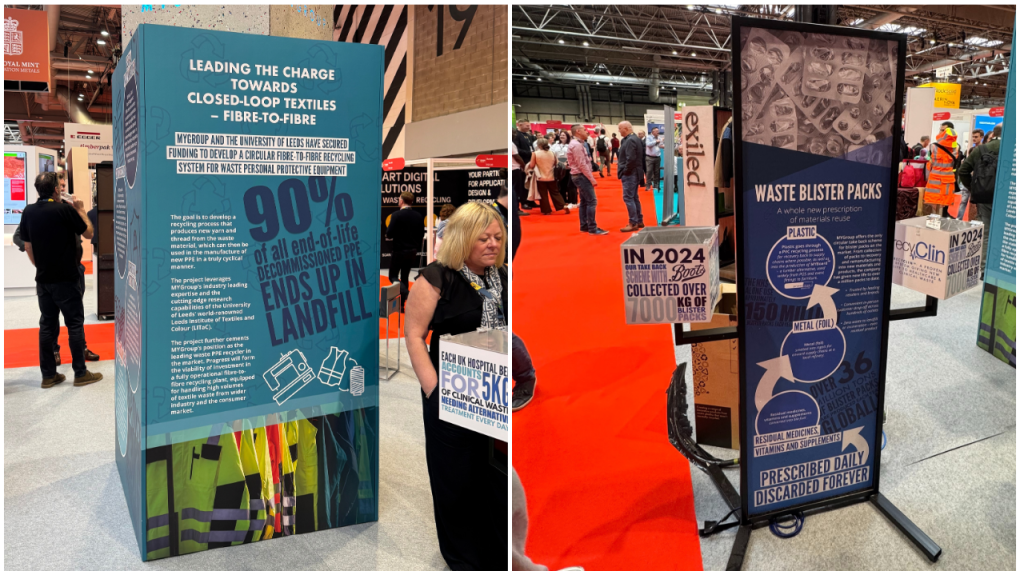
On the expo floor, one stand stood out – MYGroup. They’re tackling tricky waste streams like blister packs from medicines and PPE.
- With Boots, they’ve already recycled over 7,000kg of blister packs in 2024 by separating the plastic and foil.
- They’re also working with the University of Leeds on turning old PPE into new textiles, instead of letting 90% of it end up in landfill.
What impressed me wasn’t just the work, but how simply they explained it. Clear stats, straightforward visuals, and an easy-to-follow story. It showed that sometimes the best communication isn’t complicated – it’s bold and simple.
process to capture impact. With simple, lightweight tools, you can log daily efficiency actions like waste reduction, energy-saving, or low-carbon travel and translate them into tangible sustainability metrics.
That way, the work you are already doing is not invisible. It becomes measurable proof that your business is efficient, responsible, and aligned with modern expectations.
Culture Through Action
Linking efficiency with sustainability resonates because it feels practical and personal. Employees can see the direct benefits of saving time, cutting waste, or reducing costs and when those same actions are recognised as environmental contributions, the impact feels even greater.
This naturally builds a stronger workplace culture without the need for heavy handed policies or complex reporting. Simple tools like team shoutouts, or small rewards for efficient, low carbon choices help make sustainability feel less like a box to tick and more like a shared achievement.
Big Picture vs Everyday Action
One theme that came up a lot was the gap between big strategies and everyday action. Speakers like Wayne Hubbard at ReLondon highlighted how SMEs and start-ups often struggle to get funding, especially when every proposal now seems to need an “AI” angle. And as Stuart Hayward-Higham put it – “People are waiting for things to happen – others are getting on with it.”
It left me thinking strategies and workshops are great, but how do they reach the people actually doing the work. Maybe that’s where platforms like Greenredeem can play a role – turning those big circular economy goals into everyday actions that individuals and workplaces can actually take.
Looking Ahead
I left the RWM Expo with a note page full of ideas and a clear reminder that creativity has a real place in sustainability. The challenges – waste, education, funding – are big. But the right communication can turn them into opportunities people actually understand and act on.
For me, the day wasn’t just about learning what’s new in the sector. It was about seeing how we at Greenredeem can help translate those big industry conversations into everyday actions that feel relevant to people at home. Because at the end of the day, change only happens when individuals are engaged enough to take part.